Harvest Apron Though I haven’t treated myself to a harvest apron yet, I’m certain that once I do, it will quickly become indispensable. Imagine being able to gather your produce hands-free, simply collecting as you go. Pure magic! My plan is to craft one during the winter, a time when the garden requires less attention. And of course, I’ll share a step-by-step guide, perhaps even a video tutorial right here for you. But if you can’t wait or aren’t inclined to DIY, there are stunning options available for purchase. Here’s a link to one that I believe is top-notch!
Pruner The ideal tool for cutting back overgrown and withered plants. I also find it perfect for harvesting veggies with thicker stems, like zucchinis or small pumpkins. A sharp, well-maintained blade ensures clean cuts, making your job hassle-free. Check out this high-quality pruner I recommend.
Pruning Saw A pruning saw is particularly essential when dealing with sizable pumpkins. For a neat cut and an optimal stem length, this tool gives you perfect control. Besides its harvesting benefits, it’s also great for autumn pruning of fruit trees and robust shrubs. Fiskars is a brand I truly vouch for – its products promise quality and durability!
Top-Notch Scissors A pair of stellar scissors is a must during the harvest season! Their versatility is endless: from harvesting bunches of parsley, cilantro, and other herbs, to snipping away ties amongst tomatoes and beans, or even cutting down clusters of tomatoes and grapes. The list goes on. I never set foot in the garden without scissors in my pocket. And if ever I forget them, it’s mere minutes before I realize their necessity.
Border Fork Being a self-sufficient gardener means limited machinery for me. Most crops are no fuss given the manageable quantities I grow. But when it comes to potatoes – a staple in our garden – the right tool is non-negotiable. I swear by the border fork to delve beneath the plant and unearth every potato it has nurtured. Traditional large shovels make the job dauntingly heavy, while a smaller spade or bare hands may leave some potatoes unharvested. The border fork, however, aerates the soil, ensuring you retrieve each hidden gem.
In the world of gardening, the right tools can truly elevate your experience. These are my top picks, and I’d love to hear about your essential tools in the comments below!
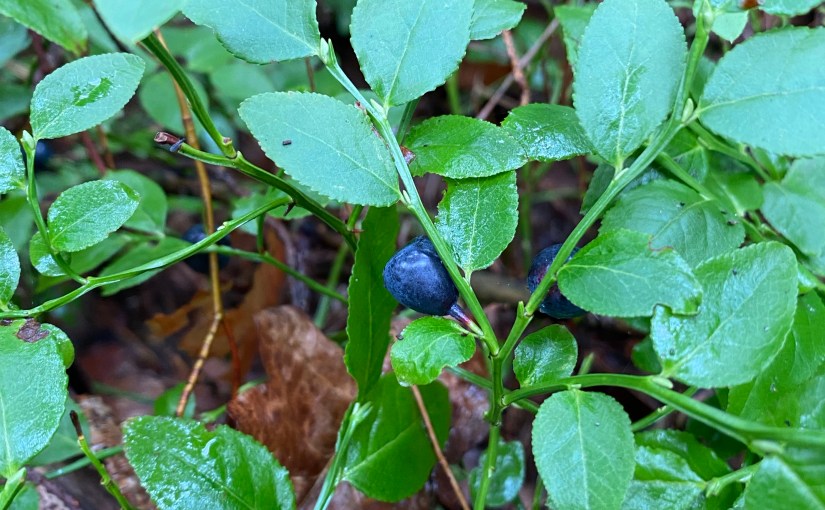
Before parenthood, my blueberry-picking adventures resembled a well-oiled machine. I’d zoom through the forest, swiftly and efficiently collecting buckets full of juicy blueberries to fill my freezer. However, with kids in tow, the blueberry-picking experience has transformed entirely.
First and foremost, there’s the challenge of coaxing them into the forest. On our path, every snail, intriguing stick, radiant flower, and beetle demands attention. Each one must be meticulously inspected and appreciated before we can proceed. Once we venture deeper into the woods, the adventure continues. There are branches perfect for balancing acts, and rocks just waiting to be scaled. Patience, indeed!
Finally, we reach our destination: the blueberry haven. As I settle down to pick, my child’s enthusiasm to join in lights up my heart. So, we pick together, engaging in heartwarming conversations amidst the blueberry bushes. This quality time amidst nature becomes more valuable than any bucket of berries.
But, as lunchtime looms, our little adventure wraps up. As I look into our container, just a handful of blueberries grace the bottom. The freezer might remain berry-less this time, but the day offers something even more precious: a perfect lesson in mindfulness, taught by the best teachers – our children!
In the gentle realm of gardening, there lies a profound lesson on one of mindfulness’s core attitudes: letting go. This blog post delves deep into how our gardens can teach us the practice of letting go and how this simple act can have profound effects in other facets of our lives. After all, embracing the present moment often means releasing the past or our preconceived notions.
Understanding the Nature of Gardens
Nature, in all its untamed beauty, refuses to be completely controlled. This is true for our gardens as well, regardless of our best efforts to shape them. While certain aspects remain within our grasp, others elude our control. The dynamics change with people, gardens, seasons, and years. And just as mindfulness isn’t about mastering something to use constantly in every life scenario, it’s about knowing when and where to apply it.
The Essence of Letting Go
Is letting go synonymous with admitting defeat? Far from it. Letting go stands in stark contrast to the act of desperately holding on. It’s a journey from confinement to liberation. Intense desires often lead us to a point where our fixation becomes suffocating. Sometimes, the tighter we grip, the more detrimental it becomes, especially if our efforts seem fruitless. The challenge then is not about how much we’ve invested but about finding the courage to release. In setting ourselves free from these chains, not only do we find peace, but often, the universe surprises us in ways we hadn’t imagined, opening doors we hadn’t noticed while we were too focused on a closed one.
Practicing Letting Go in the Garden
My garden has taught me countless lessons. Have you ever nurtured your plants to the point they withered? Or been so engrossed in one aspect that others were left neglected? Or pursued garden perfection only to be left feeling drained? The garden offers endless opportunities to practice letting go. From allowing nature to take its wild course, to moving away from perfectionism, to discarding plants that no longer serve their purpose. For instance, discarding frail tomato plants might be difficult, especially when you’ve invested so much love. Yet sometimes, holding on brings more pain than release. Whether it’s the towering weeds or the unkempt lawn, sometimes the best action is inaction. After all, a few imperfections don’t define your garden’s beauty or worth.
From the Garden to Life
Our gardens become our safe haven, free from judgment, allowing us to practice letting go. With every lesson learned among the flowers and leaves, we find the confidence to apply the same in life’s broader canvas. Letting go isn’t about giving up; it’s about making space. Just like taking a breath, releasing it, and making room for the next.
It’s time to stroll into your garden, shedding any notions of perfection or predetermined standards. Embrace it for what it is, and you’ll find yourself looking at it – and perhaps life – with rejuvenated eyes.
Dive into a critical component of mindfulness in this blog post: acceptance. Being one of the nine attitudes shaping our day-to-day life, acceptance guides us like a compass through a spectrum of situations, from the mundane to the monumental. While acceptance can be a challenging concept, its transformative potential is simply staggering. This article will not only break down the multifaceted concept of acceptance but also share how to integrate it into different aspects of your life. Particularly, we will discover how this approach can be cultivated through gardening, nourishing both your personal growth and your connection with nature.
The Power of Acceptance Contrary to popular belief, acceptance is far from passive—it’s a potent force! It’s the cornerstone that allows you to respond to situations most effectively. Only by acknowledging and accepting the reality of circumstances can you make the informed decision to act or not, thereby steering towards the outcomes you desire. Acting without understanding and accepting the facts could result in misguided decisions and may leave you miles away from your goal. Acceptance provides the foundation for your journey, and it’s you who charts the course from there. Embracing acceptance can also bestow a sense of serenity, enabling you to let go and simply be present.
The Journey to Self-Acceptance
At the heart of acceptance is a crucial concept: self-acceptance. It’s about embracing your authentic self, without the filters of societal expectations or personal aspirations. Is it an easy feat? Probably not. It’s likely a lifelong journey. But every small step counts. Recognizing and accepting our true selves gives us the autonomy to either continue our current path or venture onto a new one. It presents the potential for change as well as the freedom to appreciate what we already have and who we already are.
Gardening as a Metaphor for Acceptance
Gardening offers an excellent platform for practicing acceptance. The garden is a realm where we have limited control, and changes can only be achieved by accepting the fundamental conditions. For instance, stubbornly planting a seed in frozen soil, ignoring the cold grasp of winter, will leave you with a barren patch—the seed simply won’t germinate. Ignoring a drought and pretending it’s raining will only lead to the demise of your plants. Acceptance in such scenarios translates into action—we water our plants during droughts.
To Act or Let Be
Acceptance not only equips us with the ability to take action but also the strength to allow things to be as they are. We often find ourselves striving to change aspects that might not require alteration. Embracing the reality of these situations can liberate us from futile struggles, freeing up energy for other areas of our lives. Interestingly, once we accept situations, they often begin to resolve themselves in unexpected ways. While it might seem magical, it’s more about the energies we invest or choose not to invest—and both paths can lead to profound results.
In Conclusion, the art of acceptance can lead to seemingly magical outcomes. In essence, it bestows upon you the power to choose your path.
How has gardening, or your interaction with nature, aided you in practicing acceptance? Is acceptance a concept you find difficult or relatively easy to embrace? I would love to hear your experiences and insights in the comments, facilitating a space where we can learn and grow together!
Welcome to a blog post that delves deep into the art and science of gardening and the profound influence your personal style has on your green corner. This exploration not only paves the way for understanding your gardening quirks and practices but also broadens your perspective about the myriad ways gardening is perceived and practiced. Through this post, you’ll gain insightful knowledge about how your unique gardening style can shape the beauty and bounty of your garden. Moreover, you’ll uncover effective strategies to embrace your gardening style, thereby enhancing your satisfaction and affection for your garden.
Ever found yourself comparing your garden with others? Do you feel your garden doesn’t quite live up to your expectations? Do you persistently plant the same crops only to face disappointment? I can relate, as these thoughts often cross my mind, draining my energy and creativity. But, fear not! I’ve stumbled upon a mindset that provides a fresh perspective and I am thrilled to share it with you.
Unleashing the Power of Your Gardening Style
The significance of your gardening style is profound; it’s intertwined with your personality and leaves an indelible imprint on your garden. Are you the type who adheres to the gardening guidebook or do you blaze your own trail without much concern for the rules? Do you find yourself often underwatering or overwatering? Are you a meticulous planner, armed with elaborate to-do lists, or do you lean towards a more spontaneous approach? All these factors dictate the final outcome in your garden and create the diversity we see in gardens worldwide. It also explains why different gardeners may offer different solutions to identical problems and why we repeatedly succeed or fail in specific areas. By recognizing and embracing your gardening style, you can create a garden that is a true extension of yourself.
Identifying Your Gardening Style
So, how do you go about identifying your gardening style? It’s simpler than you think. Start by observing yourself and your garden. Mindfulness can be a powerful tool in raising your awareness about your actions and their impact on your garden. Here are a few questions to help you kickstart this process: Are your plants frequently a casualty of over or under-watering? Are you a stickler for instructions or do you let your intuition guide you? Is there a task in the garden you often overlook? Is there an aspect of gardening you find monotonous? What gardening tasks do you truly enjoy?
Selecting the Right Plants and Crops
With a clearer understanding of your gardening style, it’s time to adjust your garden and your choice of plants accordingly. If you enjoy following instructions, then make it a point to read about plants before purchasing them. Choose plants that harmonize with your gardening style. If you often forget to water, opt for drought-tolerant species. If you detest weeding, consider interplanting or cultivating ground cover plants. If you’re a gardener who trusts your instincts, that’s fantastic! Start experimenting and apply the ‘trial and error’ method. Analyze why certain plants thrived and others failed. If it’s due to your gardening practices, consider not planting that particular crop next year.
Conclusion
Your contribution to your garden is invaluable, and a deeper awareness of your gardening style can pave the way for greater success and a reduction in frustration. By cultivating plants that align with your style, you can make your gardening journey more enjoyable and take pride in your personal haven. Your garden, in essence, becomes a reflection of your personality. So, the next time you take a sneak peek over your neighbor’s hedge, you may uncover something unique about their gardening style!
I’m eager to hearing about your unique gardening styles and learning about any adjustments or innovations you’re considering for your own gardening practice. Is there a specific plant or crop that consistently poses a challenge, demanding relentless efforts each year? In my case, it’s cabbage… Despite my best efforts, I consistently struggle with adequately protecting the plants, often leading to numerous pest invasions. Yet, I stand undeterred and resolute in my refusal to back down. After all, where’s the fun in gardening without a few trials and tribulations along the way!
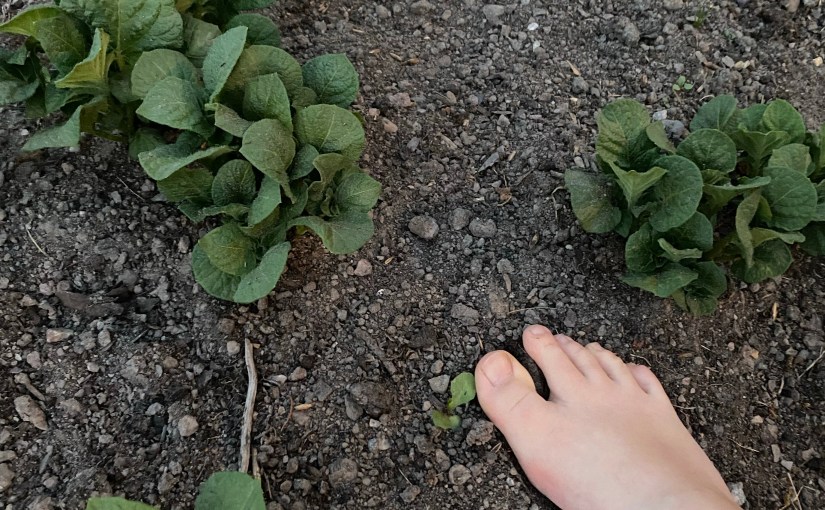
Engaging in gardening while barefooted offers an unparalleled opportunity to bond with Mother Earth and reap the benefits of earthing. In this post, we delve into the practice of earthing, shedding light on how barefoot gardening can enhance your overall wellness.
The advent of summer signals the perfect time to slip off your shoes. As a child, I was an avid barefoot explorer, indifferent to the terrains I trod upon—be it asphalt, gravel, grass, sand, or pine-strewn forest paths. However, as I matured, my perception transformed. The sensation of sand squishing between my toes started to bother me, the harshness of gravel became unbearable, and the touch of damp grass was no longer a favorite.
But, as it’s often said, change is the only constant. My perspective has taken a new turn, and I’ve rekindled my love for strolling barefoot. Despite the occasional discomfort and minor impracticalities, I sense its inherent benefits. I believe that it gifts me an extraordinary connection—a profound bond with the planet we inhabit. When I consciously experience the diverse terrains beneath my feet, it enlightens me in various ways.
I find myself developing heightened awareness of my feet—the toes, heels, and the weight they bear. The way I walk. The manner in which my feet interact with the underlying surface. The tangible contact with the stone, grass, and sand. I learn to appreciate the unique textures of various terrains, establishing an intimate connection.
In conclusion, the simple act of shedding your shoes and grounding yourself through barefoot gardening is more than just a quirky hobby—it’s a holistic approach to embracing nature’s subtle miracles. By indulging in this practice, you’re inviting an awakening of your senses, a renewed mindfulness, and a profound respect for our Earth. As the delicate variations of the world beneath our feet stimulate our awareness, we are reminded of the beautiful interconnectedness of life. So, the next time you venture into your garden, I encourage you to consider doing so barefoot. Embrace the opportunity to ground yourself physically and spiritually, all while nurturing the vibrant life that springs from the soil beneath you. Here’s to healthier, more mindful experiences with our remarkable planet!
Intro: Caring for plants can be a deeply rewarding and mindful practice. In this post, we’ll discuss how to connect with your plants on a deeper level by practicing mindfulness, offering practical tips for nurturing their growth while cultivating your own presence and well-being.
Embracing the Full Experience of Your Plant through Mindfulness
While it might sound a bit unconventional, the goal is to truly immerse yourself in the experience of your plant by practicing mindfulness. Often, we quickly pass by with a watering can, splashing some water, maybe removing a withered leaf, or pulling out some weeds. But taking the time to look, feel, smell, and even taste the plant can provide an incredibly beautiful and meaningful experience. It can also help us detect pests or diseases on our plants more quickly—a win-win!
Mindful Observation: Seeing Your Plant with Fresh Eyes and Enhancing Plant Health
Start by choosing a plant for mindful observation. Look at it, and I mean really look! Observe the shades of the leaves, the different parts such as the stem, leaf attachment, flower, and both the top and underside of the leaves and flower. What shapes can you see? As you observe, try to see your plant with fresh eyes, as if you’re seeing it for the first time. This practice helps you to become more aware of your plant’s needs and enhances its overall health.
Engaging Your Senses: Deepening Your Connection with Plants through Mindful Touch, Smell, Taste, and Listening
Next, engage your other senses to deepen your connection with the plant. Touch the plant. Is it smooth or rough, sharp or soft, lanky or sturdy? Smell it. Taste it, if it’s safe to do so. Listen to the sounds it makes as you touch it or as the wind rustles its leaves. By engaging your senses, you become more attuned to your plant’s needs, promoting its health and growth.
Cultivating Non-Judgment: Accepting Your Plant as It Is and Encouraging Healthy Growth
As you experience your plant, try not to judge what you see, feel, smell, taste, or hear. The plant is neither beautiful nor ugly, good nor bad. It is just as it is, right now. By practicing non-judgment, you cultivate a deeper appreciation for the uniqueness and beauty of each individual plant, which helps you provide the care and attention it needs to thrive.
Nurturing Your Plant with Love and Care for Optimal Growth and Well-being
Think of your plant as the living being it is. Just like you, the plant needs nourishment and care to grow and thrive. You might sprinkle some “gold water” or throw in a bag of fertilizer, but at the same time, you show concern for the plant, providing it with food. As you nurture your plant with love and care, you strengthen the bond between you and nature, contributing to its optimal growth and well-being.
The Benefits of Mindful Plant Care for You and Your Plants
Mindful plant care offers numerous benefits to both you and your plants:
Deepens your connection with nature
Improves your ability to detect pests and diseases early
Cultivates mindfulness and presence in your daily life
Enhances your appreciation for the beauty and intricacies of plants
Encourages sustainable and eco-friendly gardening practices
Conclusion: Embrace the practice of mindful plant care and experience the joys of connecting with nature on a deeper level. By nurturing your plants with mindfulness and presence, you’ll not only help them thrive but also cultivate your own sense of well-being and harmony with the natural world.
Interester in connecting with your plants right away? Listen to my Plant care meditation audio.
Have you tried doing some mindful plant care? What’s your experiences and realizations? I’d love to hear about it in the comments.
Everything I write here is based on our experiences with chickens and there is of course much more to say about the chickens’ housing, care, breeds, etc. When it comes to animals, it is important to check which rules apply to keeping animals where you live, as the rules differ. In much of our farming, good enough is enough, with the animals it is not enough. Animals should be very well off and it is your job and mine to make sure they get that if we decide to get them.
When we got the chickens, I felt that it was that piece of the puzzle that had been missing. When the chickens walked around the garden, I felt that now, now we have our farm for real! So now that we’ve reduced the number of animals, it’s the chickens that I miss the most and were the hardest to get rid of. I thought for a long time about how we could keep the chickens even though we wouldn’t be home as much. There was of course no solution to that. In the future I want to run a farm together with others to be able to have some freedom to go away, but we are not there right now. About half of the chicken group had to move to a friend and half to my sister and her husband. They have a fantastic time there!
Benefits of having chickens
Home comfort
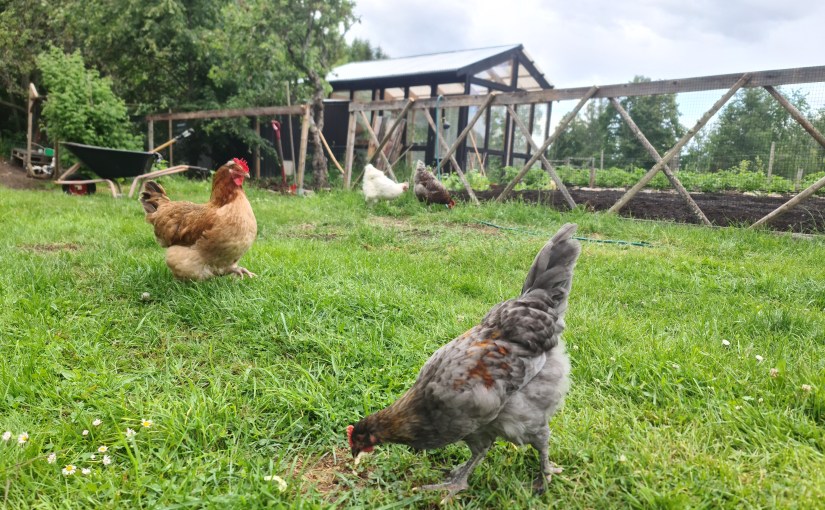
Chickens are so very cozy to have around. Our chickens have not exactly been tame, but they have always come forward and been curious when we have been pottering in the garden and eating outside. When we built our greenhouse, there was one hen in particular, Åsa, who came out as soon as we took out the shovel. It was even a bit difficult to dig for her to be there right away checking for worms. As I wrote in the introduction, the chickens were really the icing on the cake when it came to getting that real home feeling and now that the chickens are not there it feels very empty. The hens also came to meet us when we got home in the afternoons and the roosters laid eggs. Maybe it was a warning but we chose to interpret it as a welcome.
Egg
We have had mixed-breed hens, Scanian flower hens, brahmas and marans. Being able to go out and get eggs that are different sizes and different colors is wonderful. When you, like me, were used to bought eggs in one color and the same size, it’s like a new world opens up. I also know that my chickens are doing well, being cared for and being seen as individuals rather than products. In summer, when the hens eat fresh grass, the yolk turns magically yellow and both sponge cake and pancakes become so yellow that it looks like they contain saffron. It’s also a bit special to go and wait for eggs like the time we were going to bring eggs to bake at my parents’ house. We didn’t have that many eggs and then had to wait for the hens to lay before we left. Hens lay eggs at different times of the day, not just in the morning as you often hear. Ours have never laid so early that we can go out and get our breakfast eggs the same day.
Easy to care for
Chickens are very easy to take care of. Once the henhouse and henhouse are in place, they need care, food and water, cleanly in the nests and under the perch. When you don’t have that many chickens, it’s easy to keep an eye on them and see if any are sick. There is a lot of good information about diseases and mites etc. both in books and on the internet. We built our own, large food and water containers so that we didn’t have to refill so often. Under the perches we had a board that was easy to scrape off and the nests are easy to keep clean by having a newspaper in the bottom and straw on it. Some hens poop a lot in the nests, others not at all. They appreciate simple things like little sticks or branches to sit on in the chicken coop and are curious when you give them something new to eat or investigate.
Eating leftovers
Chickens like to eat food scraps. What is not eaten, they quickly scatter into the soil. We let our chickens have access to the compost and there they spread around and created fantastically fine soil. Most of the soil didn’t stay in the compost but ended up outside but it didn’t matter because there were no food scraps left after the chickens were there.
Manure
We have used chicken droppings and litter in our countries with very good results. Since we have dirt floors in our chicken house, we haven’t mowed out as often as you need to if you have concrete floors, but there has still been a lot of material to spread out on the farms. We have stored the poo from the board under the perches in buckets during the winter and then spread/buried it in the fields when the frost has left the ground. In the summer, we buried the manure directly in the fields, though not right next to the crops but a little on the outskirts.
Weed control
Our chickens have been allowed to go to the farms both spring and autumn to clear weeds and bounce around plant parts. It’s a great help to get and the hens get extra green pasture. I have had ideas about letting the chickens go in mesh tunnels around the crops to keep grass and weeds away without them getting to the crops. An idea I saw on pinterest. Unfortunately, it didn’t work out this time, but the next time we have chickens, I will definitely try it somehow.
Easy to breed
Raising chickens is both easy and fun. If you have a broody hen, I would say that it is absolutely the easiest. The hen takes care of everything and protects the chicks from the first moment. We had a small section inside the hen house where the chickens and the hen had to be for the first time. Mostly because the chickens would get the right food and get a little bigger before they had to meet the other hens. Unfortunately, we only had one hen that brooded all the way to hatching. Therefore, we mainly raised chickens in egg hatching machines. It is very smooth with a good machine and it is very exciting to see when they emerge from the shell. But it feels a little sad that they don’t have a warm and good hen to take care of them. One thing to keep in mind if you want to raise chickens is that there are as many roosters as hens and the roosters are not very easy to sell. So if you are going to breed, you need to have a plan for the roosters. It is not possible to have too many roosters in the hens. They mate too much and the roosters who are not the first cock are often quite mean to the hens. They hunt them and force them to mate. A good rooster dances for the hens and thus asks for consent, he also respects a no. If you have too many roosters, they also fight among themselves quite a bit.
Disadvantages of chickens
I almost want to say that there are none. They are wonderful animals! But sure, there is some stuff, but notice that it has nothing to do with the chickens themselves but things around them.
Predator
How many chickens have we lost to predators… We have secured and fixed but the pigeon hawk has taken to the bushes and thickets and the fox has broken in. It’s terrible when it happens. You do your best to protect them, but at the same time we don’t want to lock them up like in the egg factories and then there is always a risk that the predators will get to them. Our dog was our best protection against the fox. It was when she was away for a weekend that it hit. Against the pigeon hawk, it was probably our own presence. When I was working at home and we were on parental leave, we could run outside when we heard the dove hawk screeching and chase it away. It was before that, when we worked full-time and were away from home during the day, that the pigeon hawk succeeded in its hunt.
Bird flu
From autumn to spring, hobby chickens must be inside the fence because then there is a risk of contracting bird flu. If you sell eggs or chickens, the rules are even stricter than for hobby chickens. I won’t go through the rules here because they can change. Go to the authority’s website for current information. But what I can say is that it will be more complicated to let the chickens remove spring grass in the fields and there will be a lot of pressure on the fenced chicken coop. In any case, the way we had the chickens with a fenced part and then free as soon as we ourselves were at home and could guard against predators.
As you probably understand after reading this post, I strongly recommend having chickens! Wonderful creatures that really contribute to life on the farm or in the garden and you get eggs without a guilty conscience. Some final tips:
Build bigger than you think. Everyone says so and we read it before we built our first chicken house out of an old dog house. Of course, it was way too small and since I didn’t listen to this advice, maybe you won’t either, so my advice is instead be prepared to expand or rebuild.
Read about the rules for bird flu and adapt your chicken coop to suit your and the chickens’ needs. In recent years, the restrictions have lasted for several months, so it’s worth taking stock of it.
Everything I have written is based on our experiences with chickens and there is of course much more to say about the chickens’ housing, care, breeds, etc. When it comes to animals, it is important to check which rules apply to keeping animals where you live, as the rules differ. In much of our farming, good enough is enough, with the animals it is not enough. Animals should be very well off and it is your job and mine to make sure they get that if we decide to get them.
If you fancy chickens, I hope you dare to take the plunge after reading this post. We need more hens who are doing well and more people who get to live with these lovely birds.
Unveil the flavors of fresh garden produce and the richness of lentils in this hearty and zesty stew. This dish is not only bursting with nutrition but also caters to your comfort food cravings. Whether you’ve had a long day at work or just need a quick dinner fix, this stew has got you covered.
1 bouillon cube (choose vegetable or chicken based on your preference)
Chili flakes, to taste
Juice of 1 lime
Salt, to taste
Pepper, to taste
Butter or oil, for frying
Instructions:
Preparation: Begin by washing your leek and carrots. Slice the leek finely and dice the carrots into even pieces. Rinse the red lentils under cold water until the water runs clear.
Sauté the Veggies: In a large pot or skillet, heat the butter or oil over medium heat. Once hot, sauté the leeks and carrots until they begin to soften and the leeks become translucent.
Simmer the Lentils: Add the washed red lentils, crushed tomatoes, and enough water to cover the ingredients. Crumble in the bouillon cube and stir everything together.
Cook to Perfection: Bring the mixture to a boil, then reduce the heat and let it simmer. Cook until the lentils are tender, which usually takes around 15-20 minutes.
Season & Serve: Once the lentils are cooked through, season your stew with chili flakes, freshly squeezed lime juice, salt, and pepper. Give it a good mix and taste, adjusting the seasonings if necessary.
Dish Out: This versatile stew pairs beautifully with a side of your choice. Whether it’s fluffy rice, al dente pasta, crusty bread, or even boiled potatoes – choose what complements your palate.
Tips:
If you prefer a creamier texture, consider blending half the soup and mixing it back in.
Garnish with fresh herbs like cilantro or parsley for added freshness.
Enjoy the burst of flavors and the comforting warmth of this delightful red lentil stew. Don’t forget to share your cooking experience in the comments below!
I love parsley! It’s probably my absolute favorite spice. I can take a leaf and just go and eat it. Parsley or leaf parsley doesn’t really matter to me. Parsley is very full and good, but can also become a little earthy and dirty in the “mug”. Leaf parsley, on the other hand, probably tastes a little less, but is clean and easy to take and eat right away. Last year we only grew leaf parsley and it turned out so amazingly nice. We have a lot in the freezer and ate so much this summer. Unfortunately, I think the parsley loses some of its flavor when stored. Regardless of whether I freeze or dry, there is a very big difference compared to eating it fresh. Boring in the winter, but it makes you want to grow and eat extra during the summer!
To sow
Parsley can advantageously be sown indoors as early as March, but it is also possible to sow it directly on the plant site in May. I do as I usually do and sow it in a trough. I don’t know if it’s the best or if it fits better in a plug tray but the best seed is the one that is sown so do what you feel suits you. Parsley sows about 0.5 cm deep. I’m not too particular about that sort of thing either… But if you want to do exactly that, I can recommend taking a flower stick and marking up 0.5 cm. Stick it in the soil and you have a nice little hole that is just the right depth. Last year we grew parsley in clusters and it worked very well so this year I sowed it in groups with several seeds together. Parsley is biennial, but the second year it likes to bloom, so if you don’t want to take your own seeds, it’s best to remove the inflorescence as early as possible. Then the parsley continues to produce leaves.
To grow
When the parsley comes up and you see that the roots are on their way to the bottom of the pot or tray, it is time to replant. If it’s warm enough, you can put it outside immediately, tempering if necessary. I guess I will repot mine and have them in the greenhouse a few weeks before planting in the garden. With all spices, I prefer to have them near the kitchen. Put them in a pot or a piece of land near the kitchen and it’s easy to go out and harvest when you need to.
To harvest
Parsley is harvested continuously during the season. The more you harvest, the more new leaves come. I prefer to harvest when I’m going to use the parsley because it quickly gets a bit boring after harvesting. Parsley leaves in particular quickly begin to droop and dry if left out. Parsley can stand in a glass of water for a few days. Make sure the plant has grown and feels strong before you harvest for the first time.
To store and refine
As I said, I have both dried and frozen parsley. Of those ways, I prefer freezing. I think it saves most of the flavor although it is nowhere near the fresh parsley. It is very good to mix parsley with garlic, salt, pepper, oil and some nuts, as a variation on pesto. The stem can be added to soup which is then mixed or you pick up the stems when the soup is ready.
Quick guide
Pre-cultivate in March, approx. 0.5 cm deep or sow directly on the cultivation site in May
Harvest when the plant is strong, the more you harvest the more will come







 Grounded gardens