
Embracing Nature’s Transitions: A Mindfulness Opportunity

Every fall, I’m deeply moved by the profound transformation that occurs in nature. On one hand, this change sneaks in subtly, while on the other, it can be sudden and dramatic. The color variations in an entire forest may shift slowly, but a single tree can transform virtually overnight after a frost. Autumn often conjures up images of vibrant colors and the transition from warm summers to cooler temperatures. However, there’s more – a shift in the fragrances in the air and the textures of clothes we don as the chill sets in.

Practicing mindfulness involves harnessing our senses to immerse in the present moment and focus. These seasonal transitions offer a beautiful backdrop to pause, relish the moment, and absorb the ongoing metamorphosis. If we don’t, time speeds by, and before we know it, autumn’s splendor has passed unnoticed.

Seeing New Colors

During autumn, nature undergoes a palette swap. While summer is characterized by a lush green canvas dotted with vibrant blooms, autumn doesn’t conform to a monochrome backdrop. Here, especially in southern Sweden, the landscape is painted primarily in hues of gold, brown, and red. These colors merge and mix, creating a harmonious view without any single element standing out. Take a moment to observe your surroundings. Refrain from labeling them as beautiful or not; simply witness them.

The Changing Fragrance

Do you sense the freshness, almost a crispness in the air? To me, the cool air feels like a refreshing dip on a scorching summer day. This invigorating air carries unique aromas, varying based on your location. When I walk through our woods near the house, summer air is perfumed with the scent of pine. Come autumn, the fragrance shifts to moist leaves and mushrooms. Explore and identify the scents around you. Instead of pinpointing the source, immerse yourself in the fragrance without judgment.

Autumn’s Attire

In summer, clothing often feels like a necessary inconvenience. Though they provide protection against the sun, many of us prefer lightweight, breezy attire for comfort during warm days. With the advent of autumn, I revel in outfits that I can truly feel on my skin – clothes that warm, embrace, and protect. While I adore snuggling into cozy turtlenecks and warm socks, I often overlook truly experiencing them. This year, I aim to pause, to truly feel the fabric against my skin, meditating on the contact between cloth and skin. Again, the focus isn’t on judgment, but on being in the present moment, feeling the autumn attire.

Savor the shift, cherish the autumn!

Warmly, //Amanda

Cover image by The Vegan Monster

Reaping the Harvest: A Time for Gratitude

The harvest season is synonymous with bustling activity and is also an opportune moment to embrace gratitude. Amid the busy schedules of reaping, processing, children going back to school, and many resuming work after vacations, taking a moment for thankfulness might seem counterintuitive. But if you’ve been looking to cultivate a sense of gratitude, there couldn’t be a more fitting time than now.

In every garden, certain crops, fruits, or berries might flourish more than others each year. The relative success or failure isn’t the focal point here. When practicing gratitude, comparisons have no place. It’s not about measuring against past yields or other crops. It’s about feeling grateful for exactly what you’ve received. Embracing this mindset anchors us firmly in the present.

The Subtleties of Genuine Gratitude

It’s easy to deceive oneself into believing they’re feeling gratitude in the moment without actually delving into comparative evaluations. Let’s assess a few familiar statements:

  • “I’m so grateful that this year’s potato yield was better than last year!”
  • “I’m thankful my blueberry plants flourished when I had doubts!”
  • “The corn didn’t fare well, but thankfully, we got a lot of pumpkins!”
  • “I’m grateful for that single chili, though I wish we had more.”

Sound familiar? Many of us are conditioned to evaluate and compare. We label things as good or bad, commend each other, and classify matters as abundant or scarce. This isn’t inherently wrong. It’s a method to simplify the world and interact in universally understood terms. But while fostering gratitude, try sidelining this comparative mindset. Consider:

  • “I’m grateful for the potatoes.”
  • “I’m thankful for the blueberries.”
  • “I’m grateful the pumpkins.”
  • “I’m thankful the chili.”

It’s as straightforward as that. Yet, isn’t it tempting to add a little “but” after each statement? Resist that urge! Halt that thought before it veers into making excuses, comparisons, or judgments. Simply relish the gratitude, right here and now.

Wishing you bountiful blessings!

Cover image by RDNE Stock project

The Mobile Game Trap: Finding Balance in a Digital World

This summer, as the sun kissed the earth and life seemed a bit more relaxed, I stumbled upon a new game on my phone. The game was one of those colorful, captivating puzzles where the objective was to pour colors between different bottles until each bottle had a single hue. In essence, it was designed for mindless entertainment. A true pastime.

It was refreshing to have it during the summer siestas. But as we transitioned from the leisure of summer to the demands of everyday life, I found the game consuming more of my time than I’d like. Especially time I didn’t intend to spend. That’s the trap with these games. They’re crafted to make you want to keep playing.

If you don’t succeed in a level, the urge to retry is powerful. And when you finally succeed, the joy pushes you to attempt the next. Before you know it, hours have passed. It’s a cycle that’s hard to break.

A few years back, during my early tryst with mindfulness, I cleared my phone of similar time-consuming apps like Candy Crush. I also reduced my notifications, tailoring them to only what I genuinely needed. Personal choices that aimed to reduce digital noise.

However, now that I use the same phone for both personal and work purposes, managing notifications has become a challenge. I wonder if there’s a way to schedule notifications? If anyone has insights, do share!

A week ago, I finally deleted that color-pouring game. Though, in a moment of boredom, I did reinstall it. But starting from scratch made me remember why I removed it in the first place. It didn’t take me long to delete it again. Liberation, at last! I’m hopeful this decision will stick, at least until the next summer.

How about you? Are there apps that you find irresistible? How do you manage the pull? In this digital age, sharing strategies to reduce distractions can help all of us focus on what truly brings joy, energy, and positivity into our lives.


Seeking more tech-life balance tips or want to share your own experiences? Drop a comment below! Let’s journey together towards a mindful digital world.

Unveiling Acceptance: A Vital Key in the Nine Attitudes of Mindfulness

Dive into a critical component of mindfulness in this blog post: acceptance. Being one of the nine attitudes shaping our day-to-day life, acceptance guides us like a compass through a spectrum of situations, from the mundane to the monumental. While acceptance can be a challenging concept, its transformative potential is simply staggering. This article will not only break down the multifaceted concept of acceptance but also share how to integrate it into different aspects of your life. Particularly, we will discover how this approach can be cultivated through gardening, nourishing both your personal growth and your connection with nature.

The Power of Acceptance Contrary to popular belief, acceptance is far from passive—it’s a potent force! It’s the cornerstone that allows you to respond to situations most effectively. Only by acknowledging and accepting the reality of circumstances can you make the informed decision to act or not, thereby steering towards the outcomes you desire. Acting without understanding and accepting the facts could result in misguided decisions and may leave you miles away from your goal. Acceptance provides the foundation for your journey, and it’s you who charts the course from there. Embracing acceptance can also bestow a sense of serenity, enabling you to let go and simply be present.

The Journey to Self-Acceptance 

At the heart of acceptance is a crucial concept: self-acceptance. It’s about embracing your authentic self, without the filters of societal expectations or personal aspirations. Is it an easy feat? Probably not. It’s likely a lifelong journey. But every small step counts. Recognizing and accepting our true selves gives us the autonomy to either continue our current path or venture onto a new one. It presents the potential for change as well as the freedom to appreciate what we already have and who we already are.

Gardening as a Metaphor for Acceptance 

Gardening offers an excellent platform for practicing acceptance. The garden is a realm where we have limited control, and changes can only be achieved by accepting the fundamental conditions. For instance, stubbornly planting a seed in frozen soil, ignoring the cold grasp of winter, will leave you with a barren patch—the seed simply won’t germinate. Ignoring a drought and pretending it’s raining will only lead to the demise of your plants. Acceptance in such scenarios translates into action—we water our plants during droughts.

To Act or Let Be 

Acceptance not only equips us with the ability to take action but also the strength to allow things to be as they are. We often find ourselves striving to change aspects that might not require alteration. Embracing the reality of these situations can liberate us from futile struggles, freeing up energy for other areas of our lives. Interestingly, once we accept situations, they often begin to resolve themselves in unexpected ways. While it might seem magical, it’s more about the energies we invest or choose not to invest—and both paths can lead to profound results.

In Conclusion, the art of acceptance can lead to seemingly magical outcomes. In essence, it bestows upon you the power to choose your path. 

How has gardening, or your interaction with nature, aided you in practicing acceptance? Is acceptance a concept you find difficult or relatively easy to embrace? I would love to hear your experiences and insights in the comments, facilitating a space where we can learn and grow together!

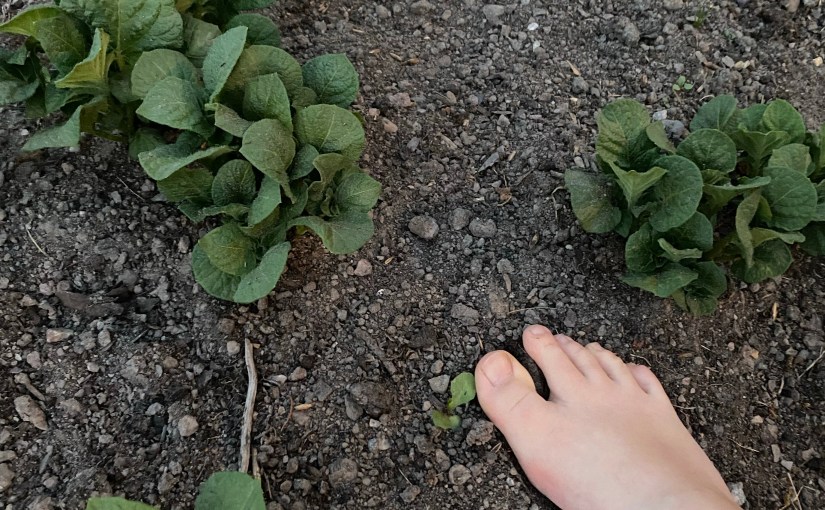
Grounding in Nature: Reap the Benefits of Barefoot Gardening and Earthing Practices

Engaging in gardening while barefooted offers an unparalleled opportunity to bond with Mother Earth and reap the benefits of earthing. In this post, we delve into the practice of earthing, shedding light on how barefoot gardening can enhance your overall wellness.

The advent of summer signals the perfect time to slip off your shoes. As a child, I was an avid barefoot explorer, indifferent to the terrains I trod upon—be it asphalt, gravel, grass, sand, or pine-strewn forest paths. However, as I matured, my perception transformed. The sensation of sand squishing between my toes started to bother me, the harshness of gravel became unbearable, and the touch of damp grass was no longer a favorite.

But, as it’s often said, change is the only constant. My perspective has taken a new turn, and I’ve rekindled my love for strolling barefoot. Despite the occasional discomfort and minor impracticalities, I sense its inherent benefits. I believe that it gifts me an extraordinary connection—a profound bond with the planet we inhabit. When I consciously experience the diverse terrains beneath my feet, it enlightens me in various ways.

I find myself developing heightened awareness of my feet—the toes, heels, and the weight they bear. The way I walk. The manner in which my feet interact with the underlying surface. The tangible contact with the stone, grass, and sand. I learn to appreciate the unique textures of various terrains, establishing an intimate connection.

In conclusion, the simple act of shedding your shoes and grounding yourself through barefoot gardening is more than just a quirky hobby—it’s a holistic approach to embracing nature’s subtle miracles. By indulging in this practice, you’re inviting an awakening of your senses, a renewed mindfulness, and a profound respect for our Earth. As the delicate variations of the world beneath our feet stimulate our awareness, we are reminded of the beautiful interconnectedness of life. So, the next time you venture into your garden, I encourage you to consider doing so barefoot. Embrace the opportunity to ground yourself physically and spiritually, all while nurturing the vibrant life that springs from the soil beneath you. Here’s to healthier, more mindful experiences with our remarkable planet!

Mindful Plant Care: Deepening Your Connection with Nature and Boosting Plant Health

Intro: Caring for plants can be a deeply rewarding and mindful practice. In this post, we’ll discuss how to connect with your plants on a deeper level by practicing mindfulness, offering practical tips for nurturing their growth while cultivating your own presence and well-being.

Embracing the Full Experience of Your Plant through Mindfulness

While it might sound a bit unconventional, the goal is to truly immerse yourself in the experience of your plant by practicing mindfulness. Often, we quickly pass by with a watering can, splashing some water, maybe removing a withered leaf, or pulling out some weeds. But taking the time to look, feel, smell, and even taste the plant can provide an incredibly beautiful and meaningful experience. It can also help us detect pests or diseases on our plants more quickly—a win-win!

Mindful Observation: Seeing Your Plant with Fresh Eyes and Enhancing Plant Health

Start by choosing a plant for mindful observation. Look at it, and I mean really look! Observe the shades of the leaves, the different parts such as the stem, leaf attachment, flower, and both the top and underside of the leaves and flower. What shapes can you see? As you observe, try to see your plant with fresh eyes, as if you’re seeing it for the first time. This practice helps you to become more aware of your plant’s needs and enhances its overall health.

Engaging Your Senses: Deepening Your Connection with Plants through Mindful Touch, Smell, Taste, and Listening

Next, engage your other senses to deepen your connection with the plant. Touch the plant. Is it smooth or rough, sharp or soft, lanky or sturdy? Smell it. Taste it, if it’s safe to do so. Listen to the sounds it makes as you touch it or as the wind rustles its leaves. By engaging your senses, you become more attuned to your plant’s needs, promoting its health and growth.

Cultivating Non-Judgment: Accepting Your Plant as It Is and Encouraging Healthy Growth

As you experience your plant, try not to judge what you see, feel, smell, taste, or hear. The plant is neither beautiful nor ugly, good nor bad. It is just as it is, right now. By practicing non-judgment, you cultivate a deeper appreciation for the uniqueness and beauty of each individual plant, which helps you provide the care and attention it needs to thrive.

Nurturing Your Plant with Love and Care for Optimal Growth and Well-being

Think of your plant as the living being it is. Just like you, the plant needs nourishment and care to grow and thrive. You might sprinkle some “gold water” or throw in a bag of fertilizer, but at the same time, you show concern for the plant, providing it with food. As you nurture your plant with love and care, you strengthen the bond between you and nature, contributing to its optimal growth and well-being.

The Benefits of Mindful Plant Care for You and Your Plants

Mindful plant care offers numerous benefits to both you and your plants:

  • Deepens your connection with nature
  • Improves your ability to detect pests and diseases early
  • Cultivates mindfulness and presence in your daily life
  • Enhances your appreciation for the beauty and intricacies of plants
  • Encourages sustainable and eco-friendly gardening practices

Conclusion: Embrace the practice of mindful plant care and experience the joys of connecting with nature on a deeper level. By nurturing your plants with mindfulness and presence, you’ll not only help them thrive but also cultivate your own sense of well-being and harmony with the natural world.

Interester in connecting with your plants right away? Listen to my Plant care meditation audio.

Have you tried doing some mindful plant care? What’s your experiences and realizations? I’d love to hear about it in the comments.

Happy gardening!
//Amanda

Embracing the Change: Transitioning from Winter’s Serenity to Spring’s Vibrancy

As we reach the tail end of February, the faint whispers of spring start to echo around us. Today brought rays of sunshine, tricking me into believing it was warmer than reality. The persistent winter winds were quick to correct me, reminding me of their ruling reign. Stepping out without a hat and gloves turned into a regretful decision as winter asserted its dominance.

I eagerly anticipate the arrival of spring with its warmth and sunshine, ready to embrace it wholeheartedly. However, a tinge of sorrow accompanies my farewell to the winter season, its chilling allure, and the tranquillity it brings. Ever since I battled with exhaustion depression, I’ve found myself increasingly enchanted by winter’s serene charm, while the summer season has somewhat lost its former allure.

Spring and summer are characterized by constant movement and heightened pace, whereas winter provides a peaceful respite, easing the weight of expectations. Shaking off the winter lethargy and transitioning into an active routine requires time, a gradual process. It’s the transition spring affords us, a gentle nudge to reset and rekindle our energy. The oscillation between sunny days filled with activities and hailstorm days perfect for a hot chocolate and a comforting movie is spring’s magic.

Living in sync with the seasons is my ultimate aspiration – aligning my activities and rhythm with the ebb and flow of nature. As we welcome this year, it seems we’re inching closer to this dream.

Stay well, cherish the final week of winter, and welcome the rejuvenating spring with open arms!