
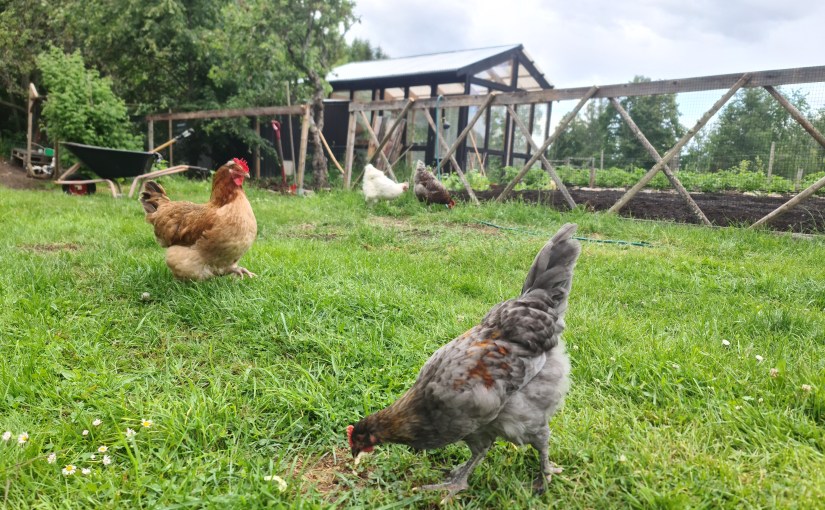
Everything I write here is based on our experiences with chickens and there is of course much more to say about the chickens’ housing, care, breeds, etc. When it comes to animals, it is important to check which rules apply to keeping animals where you live, as the rules differ. In much of our farming, good enough is enough, with the animals it is not enough. Animals should be very well off and it is your job and mine to make sure they get that if we decide to get them.
When we got the chickens, I felt that it was that piece of the puzzle that had been missing. When the chickens walked around the garden, I felt that now, now we have our farm for real! So now that we’ve reduced the number of animals, it’s the chickens that I miss the most and were the hardest to get rid of. I thought for a long time about how we could keep the chickens even though we wouldn’t be home as much. There was of course no solution to that. In the future I want to run a farm together with others to be able to have some freedom to go away, but we are not there right now. About half of the chicken group had to move to a friend and half to my sister and her husband. They have a fantastic time there!
Benefits of having chickens
Home comfort
Chickens are so very cozy to have around. Our chickens have not exactly been tame, but they have always come forward and been curious when we have been pottering in the garden and eating outside. When we built our greenhouse, there was one hen in particular, Åsa, who came out as soon as we took out the shovel. It was even a bit difficult to dig for her to be there right away checking for worms. As I wrote in the introduction, the chickens were really the icing on the cake when it came to getting that real home feeling and now that the chickens are not there it feels very empty. The hens also came to meet us when we got home in the afternoons and the roosters laid eggs. Maybe it was a warning but we chose to interpret it as a welcome.
Egg
We have had mixed-breed hens, Scanian flower hens, brahmas and marans. Being able to go out and get eggs that are different sizes and different colors is wonderful. When you, like me, were used to bought eggs in one color and the same size, it’s like a new world opens up. I also know that my chickens are doing well, being cared for and being seen as individuals rather than products. In summer, when the hens eat fresh grass, the yolk turns magically yellow and both sponge cake and pancakes become so yellow that it looks like they contain saffron. It’s also a bit special to go and wait for eggs like the time we were going to bring eggs to bake at my parents’ house. We didn’t have that many eggs and then had to wait for the hens to lay before we left. Hens lay eggs at different times of the day, not just in the morning as you often hear. Ours have never laid so early that we can go out and get our breakfast eggs the same day.

Easy to care for
Chickens are very easy to take care of. Once the henhouse and henhouse are in place, they need care, food and water, cleanly in the nests and under the perch. When you don’t have that many chickens, it’s easy to keep an eye on them and see if any are sick. There is a lot of good information about diseases and mites etc. both in books and on the internet. We built our own, large food and water containers so that we didn’t have to refill so often. Under the perches we had a board that was easy to scrape off and the nests are easy to keep clean by having a newspaper in the bottom and straw on it. Some hens poop a lot in the nests, others not at all. They appreciate simple things like little sticks or branches to sit on in the chicken coop and are curious when you give them something new to eat or investigate.
Eating leftovers
Chickens like to eat food scraps. What is not eaten, they quickly scatter into the soil. We let our chickens have access to the compost and there they spread around and created fantastically fine soil. Most of the soil didn’t stay in the compost but ended up outside but it didn’t matter because there were no food scraps left after the chickens were there.
Manure
We have used chicken droppings and litter in our countries with very good results. Since we have dirt floors in our chicken house, we haven’t mowed out as often as you need to if you have concrete floors, but there has still been a lot of material to spread out on the farms. We have stored the poo from the board under the perches in buckets during the winter and then spread/buried it in the fields when the frost has left the ground. In the summer, we buried the manure directly in the fields, though not right next to the crops but a little on the outskirts.
Weed control
Our chickens have been allowed to go to the farms both spring and autumn to clear weeds and bounce around plant parts. It’s a great help to get and the hens get extra green pasture. I have had ideas about letting the chickens go in mesh tunnels around the crops to keep grass and weeds away without them getting to the crops. An idea I saw on pinterest. Unfortunately, it didn’t work out this time, but the next time we have chickens, I will definitely try it somehow.
Easy to breed
Raising chickens is both easy and fun. If you have a broody hen, I would say that it is absolutely the easiest. The hen takes care of everything and protects the chicks from the first moment. We had a small section inside the hen house where the chickens and the hen had to be for the first time. Mostly because the chickens would get the right food and get a little bigger before they had to meet the other hens. Unfortunately, we only had one hen that brooded all the way to hatching. Therefore, we mainly raised chickens in egg hatching machines. It is very smooth with a good machine and it is very exciting to see when they emerge from the shell. But it feels a little sad that they don’t have a warm and good hen to take care of them. One thing to keep in mind if you want to raise chickens is that there are as many roosters as hens and the roosters are not very easy to sell. So if you are going to breed, you need to have a plan for the roosters. It is not possible to have too many roosters in the hens. They mate too much and the roosters who are not the first cock are often quite mean to the hens. They hunt them and force them to mate. A good rooster dances for the hens and thus asks for consent, he also respects a no. If you have too many roosters, they also fight among themselves quite a bit.
Disadvantages of chickens
I almost want to say that there are none. They are wonderful animals! But sure, there is some stuff, but notice that it has nothing to do with the chickens themselves but things around them.
Predator
How many chickens have we lost to predators… We have secured and fixed but the pigeon hawk has taken to the bushes and thickets and the fox has broken in. It’s terrible when it happens. You do your best to protect them, but at the same time we don’t want to lock them up like in the egg factories and then there is always a risk that the predators will get to them. Our dog was our best protection against the fox. It was when she was away for a weekend that it hit. Against the pigeon hawk, it was probably our own presence. When I was working at home and we were on parental leave, we could run outside when we heard the dove hawk screeching and chase it away. It was before that, when we worked full-time and were away from home during the day, that the pigeon hawk succeeded in its hunt.
Bird flu
From autumn to spring, hobby chickens must be inside the fence because then there is a risk of contracting bird flu. If you sell eggs or chickens, the rules are even stricter than for hobby chickens. I won’t go through the rules here because they can change. Go to the authority’s website for current information. But what I can say is that it will be more complicated to let the chickens remove spring grass in the fields and there will be a lot of pressure on the fenced chicken coop. In any case, the way we had the chickens with a fenced part and then free as soon as we ourselves were at home and could guard against predators.
As you probably understand after reading this post, I strongly recommend having chickens! Wonderful creatures that really contribute to life on the farm or in the garden and you get eggs without a guilty conscience. Some final tips:
Build bigger than you think. Everyone says so and we read it before we built our first chicken house out of an old dog house. Of course, it was way too small and since I didn’t listen to this advice, maybe you won’t either, so my advice is instead be prepared to expand or rebuild.
Read about the rules for bird flu and adapt your chicken coop to suit your and the chickens’ needs. In recent years, the restrictions have lasted for several months, so it’s worth taking stock of it.
Everything I have written is based on our experiences with chickens and there is of course much more to say about the chickens’ housing, care, breeds, etc. When it comes to animals, it is important to check which rules apply to keeping animals where you live, as the rules differ. In much of our farming, good enough is enough, with the animals it is not enough. Animals should be very well off and it is your job and mine to make sure they get that if we decide to get them.
If you fancy chickens, I hope you dare to take the plunge after reading this post. We need more hens who are doing well and more people who get to live with these lovely birds.
Best of luck with your feathered friends!

 Grounded gardens
WAY more pros than cons, and the cons are fairly preventable. Thanks for sharing
LikeLiked by 1 person
Definitely! Thanks!
LikeLike